Sunday, September 30, 2012

How to spot hidden problems in older homes.

How to spot hidden problems in older homes.


"Yikes!” “Uh-oh …”

The homeowner and I were watching our contractor remove deck boards that concealed an area of a foundation wall that we thought might have settled.

The homeowner had noticed a problem when the front door began to stick, and an unmistakable settling of the floor under the door had soon followed.

The contractor and I assumed that water had caused the foundation to settle, leading to a drop of the floor system – a relatively common problem in older homes that is sometimes easily stabilized and repaired.
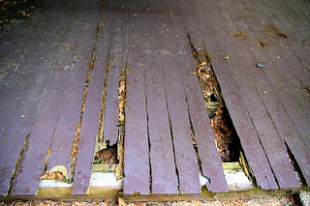
Photo: ZillowAt this house, however, the problem looked much worse. A large section of the band board – a strip of lumber that surrounds the floor system – was completely rotted.

We’d expected some damage to the band since we were sure that water (the cause of the rotting) was the culprit in the foundation settling.

But here the foundation looked intact. It was the band itself that had collapsed, causing the floor system to drop several inches. Worse yet, the damage extended well into the floor joists.

Ugh. Which one of us was going to give the homeowner the bad news – her minor settling problem in the house she’d recently purchased was rapidly becoming a very expensive major repair?

Not aging gracefully

Problems in older homes are often well hidden. More often than not, serious damage doesn’t show any symptoms until the damage is significant and expensive.

There are clues, but even trained eyes sometimes have difficulty telling normal wear and tear from the signs of serious underlying problems.

Most old-home problems, however, have predictable causes and if you know where to look you can find hints that might lead you to discover concealed damage.

Find the problems early enough and you might be able to fix them relatively easily, or keep yourself from buying into unexpected expensive repairs.

H-2-Oh no!
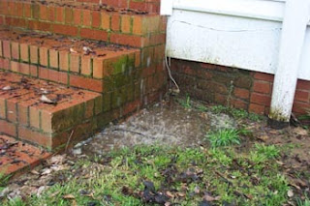
Photo: ZillowWater is the number one cause of damage in all homes, especially older ones. Look for missing or damaged roof shingles, rotted or loose trim boards, and disconnected or plugged-up gutters and downspouts.

Problems with gutters and downspouts are the biggest cause of water damage – they must be cleaned and checked regularly.

If you’re looking to buy an older home, check the condition of the gutters and downspouts – they’re big clue to finding hidden water problems elsewhere in the house.

As the ground around a home settles naturally, it can slope in toward the house and begin directing water at the foundation wall. Modern waterproofing systems can delay the subsequent damage for a while, but older homes don’t have sophisticated waterproofing systems – if they have any at all. Many very old homes have porous stone foundations that have no ability to repel ground water.

Check the grade at the perimeter of the house – settling near the foundation may indicate water in the basement.

Plug it in
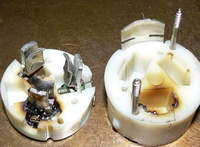
Photo: ZillowWhen your grandparents’ family gathered around the Philco radio in the 1930’s listening to the Jack Benny Show they weren’t putting much of a load on the house’s electrical system – the radio and a lamp or two may have been the only electrical appliances in the house.

But now there’s a TV in every bedroom; two or three computers; dozens of light fixtures; and a whole kitchen full of modern electrical conveniences.

The appliances have grown – has the electrical system kept pace?

Each fixture or appliance “draws” power from outside in the form of amps; the more fixtures, the more amperage required. If the fixtures need more amps than the electrical system is rated for, the system can overheat, spark, or fail entirely – all potential fire hazards.

Any home over 40 years old is a likely candidate for having an outdated electrical system. Check the electrical panel for the amperage rating – modern homes require at least 100 amps and many require much more. Older homes may have “fuse boxes” rated for 60 amps or less.

[Find the right home contractor for you. Click to compare rates now.]

Check any visible wiring to see if it’s made of aluminum, which is also considered a fire hazard and was discontinued decades ago.

Look around the house – are there lots of extension cords and plug adapters? Are there “burn marks” around some switches and outlets? Are there rooms without any outlets at all? Replacing an electrical system to remove safety risks or to bring the system up to current codes can be a very expensive project.

Home sweet (old) home
If you own an old house, keep up with the maintenance to prevent costly repairs. If you’re thinking about buying one, check carefully for the signs of hidden damage and unsafe conditions first – a little detective work might keep you from saying “Yikes!” one day.

Richard Taylor is a residential architect based in Dublin, Ohio and is a contributor to Zillow Blog. Connect with him at http://www.rtastudio.com/index.htm.
Lisa Ekanger Your Hometown Realtor!

Friday, September 28, 2012

Many assume that only pleasing relationships have value, but that is not the case.

"Every person with whom you interact is a part of the person you are becoming. Not a single interaction with a single person is left out of the process of your becoming. Many assume that only pleasing relationships have value, but that is not the case. Your awareness of an unwanted situation evokes from you a clear Vibrational request for something different. And so, even those uncomfortable interactions with others form the Vibrational basis of your expansion."
- Esther Hicks

Lisa Ekanger Your Preferred Realtor!

Thursday, September 27, 2012

Take care of your people and they’ll take care of your bottom line.


You know when you see a kid in the playground acting like a complete jackass to all the other children and you’re all ‘where is your mother?!?’ That’s how I felt with this guy working in the hardware store.
I can’t even remember what I was shopping for, the experience with the clerk was so distracting from my task at hand. He was on the phone and didn’t look up when I came in. His conversation was clearly personal and not at all urgent and he rattled along, casually cussing, before finally saying that he should probably go as though having a customer walk in was the greatest of inconveniences. I am fine with casual and rarely offended by cussing. But having owned a small business for almost a decade, my shock was in imagining one of my staff ever behaving that way.
We had a good time, he was actually pretty helpful despite his ‘I don’t give a flying f-attitude’. When he couldn’t find a price, he just made it up saying “They don’t pay me enough to care.”
What?! Where is your mother? Where is your boss?
There are several layers that are dumbfounding to me here.
First…The amount of money we make has nothing to do with how much we care about our work. It just doesn’t. If you don’t care about your work, making more money won’t make you care. It might make it more tolerable, it might make it ‘worth it’ when you weigh it out at the end of the day, you may ACT more appropriately in order to not lose the paycheck…but money CAUSING you to care about your work….doesn’t work that way.
This also goes for “Once I get paid what I’m worth, then I’ll step up and work harder”. That’s not how things work. You provide value first and remuneration rolls in. Can you imagine if I, as a coach, held back what I have to offer, hold in my energy, knowledge, insight and love and demand you pay me a really high rate and THEN I’ll show up and deliver? Nonsense.
Anything I’ve ever built- be it a company, solid client base, great staff and respectable reputation- have all come out of generously and enthusiastically offering up whatever I’ve got. My time, know-how, talent and most importantly my heart.
Being stingy will leave you with what you’re offering up…not much.
And when I say ‘Where is your boss?’ I don’t mean to reprimand…I mean to provide a little bit of leadership, culture and community in the workplace.
In my past life as the owner of a hair salon we really made things up as we went along. Having only had a few part time, short term jobs before opening the place, I hadn’t formed a whole bunch of ideas about how things should be run.
What I did notice about being an employee was that my enjoyment of my work was of little concern to most of my employers. Which is a poor business move. ..
Fact: When people enjoy what they do, they are more productive.
The subtle resistance that occurs in every move and task for someone who resents what they’re doing or even being there at all is PROFOUND.
If you have a team and you’re focused on your targets and your numbers and you’re not focused, like really focused, on your team’s job satisfaction, you’re bleeding energy that could totally boost things up.
We used to have a weekly meeting at the salon, our Haven Huddle. Here, each staff would say what their targets or goals were for the week, in terms of numbers and where they were at in accordance. Nothing revolution here- measuring the measurable results is all. But what about their job satisfaction?
Why don’t most companies measure this? Probably because it’s not empirically measurable. Job satisfaction is subjective. Can’t turn that into a system.
It would benefit us all to bring a lot more humanity to how we’re running our companies.
Here’s what we did…
It was built into our policy manual that our staff had to love their work. We hired people who truly wanted to be there, who were stoked about the unique culture of inclusion and collective support and creative expression that we’d created. In those weekly huddles, each member rated their level of job satisfaction on a scale of 1-10. If they were above an 8, they talked about what was working that had them so satisfied (on behalf of supporting the team in generating responsibility for their own satisfaction.) If they were below an 8, they shared about what was going on that created the gap and what they planned to do about it. Then, someone else on the team would offer to support them in some way.
Here’s the thing though, this doesn’t work unless management actually gives a shit. If people don’t like their job because they think their manager is a bozo, are they supposed to say that in the meeting?
As a manager in this context, you need to actually really care. You need to be open to the perspectives and opinions of the staff and actually willing to be influenced by them. That’s how a real sense of team is created rather than a dictatorship. If we had a policy that everyone must love their work and that if they don’t, there’s a threat on the other end, rather than a big hearted commitment, it would just be another false ra-ra strategy to produce a result for the company.
At the crux of all of this is offering care.
At the crux of all of this is offering love.
People need to matter. Take care of your people and they’ll take care of your bottom line.
And it’s a co-created phenomenon that makes all the difference in the work place. We’re living in a world right now where so much emphasis is put on external results and we go about measuring those and completely forget about the heart. But the heart will move us faster and further than anything else. It was clear that this kid at the hardware store didn’t care about the company, and the company didn’t care about him.
I want to live in a world where we build our work and our interactions on deep care for one another, this would lead to way deeper fulfillment when the results do come in, fewer traumas when they don’t and could weed out a whole bunch of poor decisions that harm many along the way.
Lisa Ekanger Your Hometown Realtor!